FEATURED PROJECT • CONFIDENTIAL STATE REVENUE AGENCY

Building a Field Collections Readiness System

Building a Field Collections Readiness System

Building a Field Collections Readiness System

As lead learning strategist and instructional designer, I transformed fragmented, inconsistent on-the-job training into a completed first-year readiness system with defined expectations, realistic practice, supervisor coaching, field-safety standards, performance support, and evidence-based checkpoints.

This project uses sanitized and reconstructed materials. Agency data, system details, taxpayer information, and confidential procedures have been removed or generalized.

ROLE

Lead Learning Strategist and Instructional Designer

AUDIENCE

Collectors, supervisors, and leadership

FOCUS

AI-assisted learning strategy, workforce readiness, coaching, systems adoption, and measurement

IMPACT AT A GLANCE

35

eLearning modules

Role foundations, systems, case work, judgment, safety, field readiness, and future-state workflows

200+

supporting deliverables

Curriculum maps, pathways, job aids, guides, rubrics, checklists, coaching tools, scorecards, assessments, and rollout support

BUSINESS NEED

From informal OJT to demonstrated readiness

SME discovery revealed strong source knowledge but inconsistent timelines, uneven coaching, outdated information, and unclear standards for when a collector was ready to work independently. The redesign organized that knowledge into a shared performance system.

Inconsistent expectations

Collectors and supervisors did not always share the same process, timeline, or definition of readiness.

Knowledge loss

Important judgment, enforcement, negotiation, and case-progression practices lived largely with experienced staff.

Operational risk

Missed collection opportunities, stalled cases, safety concerns, low productivity, and taxpayer dissatisfaction were cited as risks.

Technology transition

The role foundation had to remain stable while preparing employees for a future revenue-management system and new workflows.

BEFORE

Time spent in OJT

A loose collection of materials, variable coaching practices, and no shared progression standard.

AFTER

Performance demonstrated on the job

Defined milestones, realistic practice, supervisor sign-offs, and observable evidence at 90 days, six months, and one year.

First-year learning journey showing readiness milestones from week one through one year.
Three connected learning pathways for new collectors, experienced collectors, and supervisors.
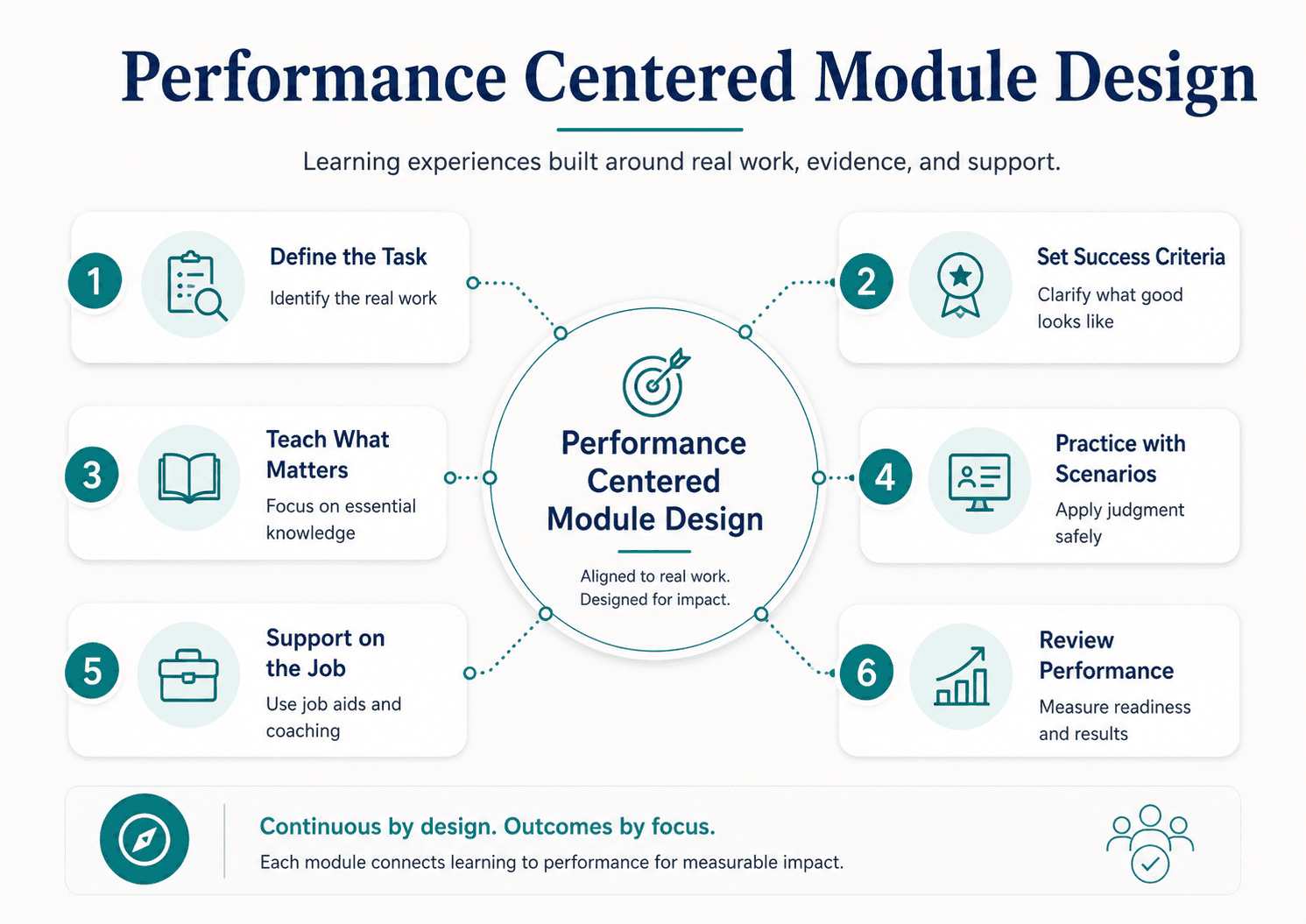
Performance-centered module design connecting real tasks, practice, support, and measurement.

Select any diagram to view it at full size.

How AI accelerated the design workflow

I used AI as a design accelerator - not as a substitute for operational expertise. ChatGPT helped synthesize extensive SME responses, surface recurring risks, organize role expectations, draft scenario variants, and refine learner-facing language. Python supported content analysis, traceability checks, consistency review, and production QA.

I remained the lead designer and decision owner. Agency SMEs validated procedures, leaders approved expectations, and human review governed every recommendation, deliverable, and readiness standard.

The Design Challenge

Fragmented source materials

Complex case decisions

Regulated work and safety

Three connected audiences

Future system transition

My AI-Assisted Workflow

SME-response synthesis

Task and decision clustering

Scenario and content drafting

Traceability and consistency checks

Human validation and final QA

The Challenge

The agency needed more than updated courses. Training varied by collector and supervisor, timelines were unclear, and critical judgment lived in experienced employees’ heads. Leadership identified risks including missed case opportunities, lost productivity, inconsistent taxpayer service, safety concerns, and turnover.

Three Connected Pathways

The program connected three audiences: a Day 1–Year 1 pathway for new collectors, modular scenario-based refreshers for experienced collectors, and a supervisor pathway for coaching, calibration, sign-off, and retraining.

Three connected learning pathways for new collectors, experienced collectors, and supervisors.

Performance Centered Module Design

Modules began with real work: define the task, clarify success criteria, teach essential knowledge, practice realistic decisions, support performance with job aids and coaching, and review workplace evidence.

Performance-centered module design connecting real tasks, practice, support, and measurement.

Preparing for Technology Change

The design protected durable capability - taxpayer service, case ownership, documentation, field readiness, safety, and professional judgment - while leaving a modular layer for future workflows, job aids, dashboards, and go-live support.

Stable learning foundation supporting future systems, workflows, job aids, coaching, and reporting.

My Leadership

I owned the learning strategy and end-to-end design direction for approximately 35 eLearning modules and more than 200 supporting deliverables. My work spanned discovery, performance analysis, curriculum and pathway architecture, applied-practice strategy, supervisor enablement, job aids, readiness scorecards, measurement, and future-system planning. I coordinated human review and retained accountability for every design decision.

Leadership Reflection

The project reinforced my core design principle: readiness must be demonstrated through observable work, consistent coaching, safe practice, sound decisions, and evidence at meaningful checkpoints. AI made the discovery and production workflow faster and more rigorous; my leadership, SME validation, and human judgment ensured the final system remained accurate, responsible, and operationally credible.

My Approach

I led SME discovery, role and task analysis, curriculum architecture, and performance-centered design. ChatGPT accelerated response synthesis, task clustering, scenario drafting, and content refinement; Python supported analysis, consistency checks, and production QA. I converted the findings into a stable role foundation with modular support for future system workflows.

First Year Learning Journey

The first-year sequence moved from role orientation and systems access through case work, enforcement foundations, field safety, shadowing, and independent worklist ownership - with readiness reviews at 90 days, six months, and one year.
First-year learning journey showing readiness milestones from week one through one year.

Learning in the Flow of Work

The solution extended beyond courses into decision guides, documentation checklists, field-safety tools, supervisor rubrics, coaching guides, observation forms, readiness scorecards, and a learner-facing new-hire manual.

Field collector readiness scorecard with evidence categories, ratings, and review checkpoints.

Readiness and Measurement System

I built measurement into the learning architecture rather than treating completion as the outcome. The delivered framework connected milestone sign-offs and field preparation to case movement, documentation quality, taxpayer communication, decision-making, supervisor coaching, safety practices, and values-based behavior. It gave leaders a consistent evidence model for 90-day, six-month, and one-year readiness reviews.

Completed Initiative

I completed the discovery, current-state analysis, curriculum architecture, and performance-centered design for new collectors, experienced collectors, and supervisors. The delivered initiative included approximately 35 eLearning modules and more than 200 supporting deliverables across the first-year pathway, modular refreshers, coaching tools, job aids, readiness scorecards, measurement, and future-system support. This portfolio uses reconstructed and sanitized visuals; confidential agency data is not shown.

The Challenge

The agency needed more than updated courses. Training varied by collector and supervisor, timelines were unclear, and critical judgment lived in experienced employees’ heads. Leadership identified risks including missed case opportunities, lost productivity, inconsistent taxpayer service, safety concerns, and turnover.

My Approach

I led SME discovery, role and task analysis, curriculum architecture, and performance-centered design. ChatGPT accelerated response synthesis, task clustering, scenario drafting, and content refinement; Python supported analysis, consistency checks, and production QA. I converted the findings into a stable role foundation with modular support for future system workflows.

Three Connected Pathways

The program connected three audiences: a Day 1–Year 1 pathway for new collectors, modular scenario-based refreshers for experienced collectors, and a supervisor pathway for coaching, calibration, sign-off, and retraining.

Three connected learning pathways for new collectors, experienced collectors, and supervisors.

First Year Learning Journey

The first-year sequence moved from role orientation and systems access through case work, enforcement foundations, field safety, shadowing, and independent worklist ownership - with readiness reviews at 90 days, six months, and one year.

First-year learning journey showing readiness milestones from week one through one year.

Performance Centered Module Design

Modules began with real work: define the task, clarify success criteria, teach essential knowledge, practice realistic decisions, support performance with job aids and coaching, and review workplace evidence.

Performance-centered module design connecting real tasks, practice, support, and measurement.

Learning in the Flow of Work

The solution extended beyond courses into decision guides, documentation checklists, field-safety tools, supervisor rubrics, coaching guides, observation forms, readiness scorecards, and a learner-facing new-hire manual.

Field collector readiness scorecard with evidence categories, ratings, and review checkpoints.

Preparing for Technology Change

The design protected durable capability - taxpayer service, case ownership, documentation, field readiness, safety, and professional judgment - while leaving a modular layer for future workflows, job aids, dashboards, and go-live support.

Stable learning foundation supporting future systems, workflows, job aids, coaching, and reporting.

Readiness and Measurement System

I built measurement into the learning architecture rather than treating completion as the outcome. The delivered framework connected milestone sign-offs and field preparation to case movement, documentation quality, taxpayer communication, decision-making, supervisor coaching, safety practices, and values-based behavior. It gave leaders a consistent evidence model for 90-day, six-month, and one-year readiness reviews.

My Leadership

I owned the learning strategy and end-to-end design direction for approximately 35 eLearning modules and more than 200 supporting deliverables. My work spanned discovery, performance analysis, curriculum and pathway architecture, applied-practice strategy, supervisor enablement, job aids, readiness scorecards, measurement, and future-system planning. I coordinated human review and retained accountability for every design decision.

Completed Initiative

I completed the discovery, current-state analysis, curriculum architecture, and performance-centered design for new collectors, experienced collectors, and supervisors. The delivered initiative included approximately 35 eLearning modules and more than 200 supporting deliverables across the first-year pathway, modular refreshers, coaching tools, job aids, readiness scorecards, measurement, and future-system support. This portfolio uses reconstructed and sanitized visuals; confidential agency data is not shown.

Leadership Reflection

The project reinforced my core design principle: readiness must be demonstrated through observable work, consistent coaching, safe practice, sound decisions, and evidence at meaningful checkpoints. AI made the discovery and production workflow faster and more rigorous; my leadership, SME validation, and human judgment ensured the final system remained accurate, responsible, and operationally credible.